Great Outdoors
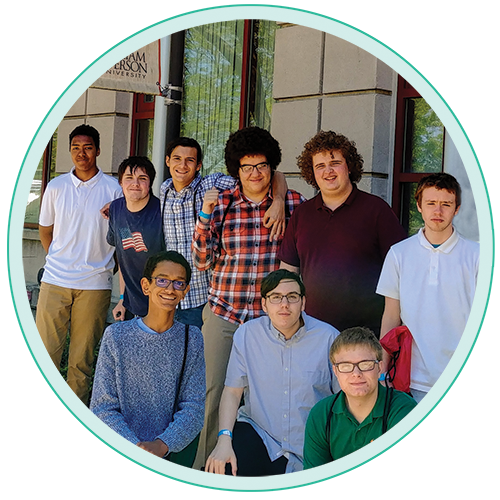
This fall, middle school students took a hike at the Pyramid Mountain Natural Historic Area in Montvale.
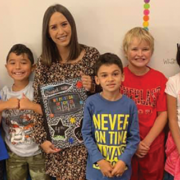
This fall, art classes at Chapel Hill Academy took a South America tour as they explored the theme of the “No Drama Llama.”
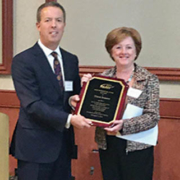
Diane Somers, Director of Chapel Hill Academy, has been recognized by ASAH, a statewide membership association comprised of more than 130 specialized schools. In November, she received the 2019 ASAH President’s Award for her leadership and vision.
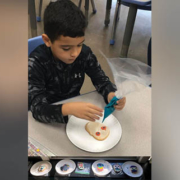
In our elementary Spanish classes, the students learned about the Mexican holiday “Dia de los Muertos” or the Day of the Dead. Dia de los Muertos is a holiday that celebrates friends and relatives that have died and aims to make sure their memories live on in their community.
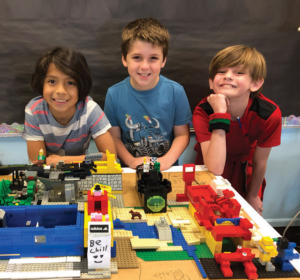
Every kid knows that you can build just about anything with Legos®. At Chapel Hill Academy, students are building confidence, joint attention, focus, negotiation skills, and problem solving. Leveraging students’ love of these colorful building bricks, this cross-curricular project has elementary students working together to create “Lego City.”

The concept for Lego City got its start through one student’s project during “Genius Mods,” an independent study module offered to students at CHA. This spring, ten students ages 7-9 took part in the multi-week project in Maureen Dahdah’s elementary school classroom.
The project is linked to many areas of the curriculum, including math (fractions) and social studies (how government and democratic decision-making works). Students named the city “FlamEngland” – a combination of flamingo and England – to reflect their studies of Colonial America.
“Building with Legos is a multi-sensory, open-ended experience, so I was able to tailor the activity to meet the students’ unique needs. The lesson plans addressed areas of the core curriculum in a way that was fun and engaging. And because it was such a team effort, students used a toolbox of skills to build cooperation and teamwork.”
— Maureen Dahdah, CHA Teacher
Congratulations to John Farris, the 2019 winner of the Ruth K. Newman Award for Excellence. The award is bestowed each year by the Council of Private Schools for Children with Special Needs to recognize teaching professionals for outstanding contributions and dedication in providing educational services to children with disabilities.
A 16-year veteran educator, John came to Chapel Hill Academy as a 1:1 paraprofessional, often tasked with supporting the most difficult students. In 2014, John was named leader of the Crisis Response Team, providing support and assistance to teachers working with students with challenging behavior, and leading staff in verbal de-escalation efforts to assist students in crisis.
“John has always excelled, remaining personable, consistent, and positive in the face of emotional and mental hardship, helping his students succeed and reach personal goals,” said Diane Somers, Director.
Thanks to all our presenters, attendees and volunteers who made our recent Career Fair at Chapel Hill Academy such a great success. Here’e a gallery of photos from our event. Enjoy!
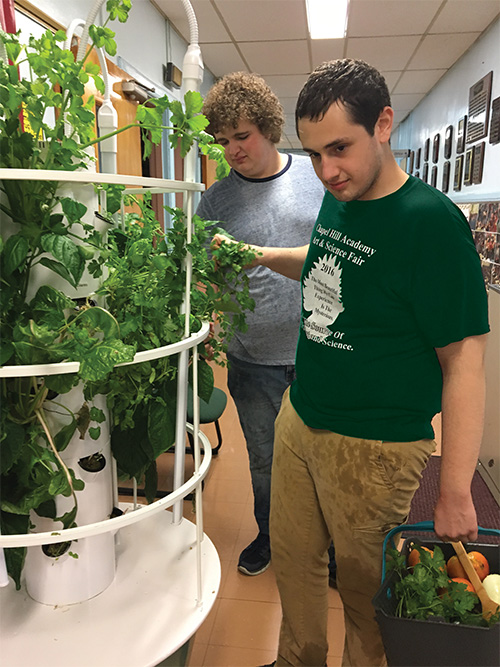
The students in biology classes at Chapel Hill Academy are not only learning biology, but also important life lessons as they grow and prepare their own food. Tammy Perkins, the biology teacher, received her Master Gardening certification and is bringing her passion and knowledge to her students through the new hydroponic gardening towers.

Last April, the Health Department of Lincoln Park received a grant as part of NJ Healthy Communities Network to purchase hydroponic towers. Chapel Hill Academy received two of these towers, which students helped to construct and continue to maintain. Hydroponic gardening is a form of indoor gardening where plants are grown year round without soil. The towers are an addition to the existing outdoor raised garden beds, which have supplied pumpkins, zucchini, broccoli, cucumbers, eggplants, and herbs.
“Gardening used to require an outdoor space and was limited by season and weather, but this is no longer the case. Hydroponic systems allow our students to enjoy the benefits of gardening all year and in any kind of weather,” said Ms. Perkins.
Hands-on lessons teach students the requirements of water and light for the plants, the importance of pH and macronutrients, the different parts of the plants that provide nutrition for the human body, the different types of flowers and the challenge of indoor pollination and insect control, to name a few. Gardening is experimental, so after trying to grow a number of vegetables, the students have already learned that the hydroponic towers are better for growing leafy vegetables such as kale, herbs and lettuces since they do not need to cross pollinate.
In addition to the excitement of monitoring the vegetables as they emerge and grow, the students work collectively to harvest the vegetables, follow recipes to cook them, and then finally eat them. Sometimes the vegetables are a variety the students are trying for the first time.
“It is exciting to have the opportunity to connect students with healthy food that they have grown themselves. They are socializing and sharing in this wonderful experience while learning important social skills, collaboration, healthy eating, and of course, biology. The benefits of gardening and connecting with nature are proven to reduce anxiety and negative feelings and I see it with my students,” said Ms. Perkins.
This winter, while the school’s butterfly waystation is void of swirling butterflies and the outdoor raised garden beds are covered under snow, students in Ms. Perkins’ biology classes will continue to grow nutritious food and enjoy warm meals together.
Students come to Chapel Hill Academy with a range of challenges, including learning disabilities such as dyslexia and dysgraphia. Some students struggle to make the connection between sounds and symbols, while others have trouble with comprehension. Any one of these difficulties can affect learning across all content areas. That is where Maggie Kondovski, LDT-C, Supervisor of Instruction, steps in.
The Remedial Reading Program at Chapel Hill Academy supports students in all grades, but specifically targets those students in grades 2-6. Ms. Kondovski conducts informal assessments several times a year, observes in the classroom, and consults with parents, teachers and counselors to identify students who might need extra support. “Together we choose a path,” she said.
Different approaches work for different students. When teaching students to read phonetically, educators create materials using Explode the Code®, a program rooted in Orton-Gillingham®. For students whose challenges are in the areas of memorization and visual discrimination, they might use the Edmark Reading Program®. Both programs are evidence-based, structured, and sequenced.
But it is not the program alone that makes the difference. “The challenge is studying the student to make a determination as to which direction best suits their specific learning needs and style,” Ms. Kondovski said.
Ms. Kondovski recalled a 3rd grader who struggled with both behavior and reading. For a full month, they met every day, just building rapport. “We didn’t discuss reading at all. I got to know him: his favorite ice cream flavor, who was in his family, and what shows he watched. That made all the difference. When I began addressing the reading, he trusted me,” she said.
Over time, she increased the reading instruction, using a phonetic approach and activities that would engage him. “We worked together every day for two years; he became a more fluent reader and developed confidence,” she said.
Under Ms. Kondovski’s instructional leadership, teachers at Chapel Hill Academy learn to alter workbooks into games to engage the students, while providing materials that are multi-sensory.
“Our students need instruction that is systematic, repetitive, and presented in varied forms. Our teachers take the time to discover what motivates each student and to develop games based on their interests. The methods and materials have changed throughout the years, but the approaches remain the same: develop a rapport and provide materials and instruction that are unique to each student,” she concluded.

Chapel Hill Academy is currently accepting enrollment for all grades. If you are interested in more information, please contact us.